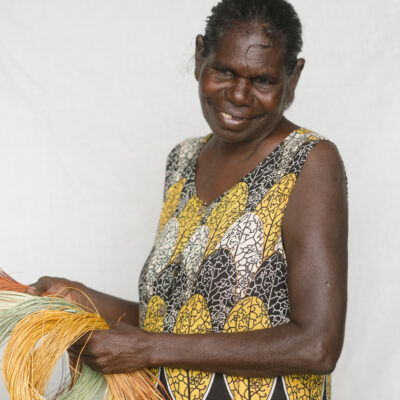
Helen Ganalmirriwuy Garrawurra
Milingimbi Art and CultureHelen Ganalmirriwuy was born in Galiwin’ku (Elcho Island) and grew up on La?arra (her mothers homeland, also known as Howard Island). Her father’s country, Garriyak, is on the mainland south of Galiwin�ku and La?arra.
Ganalmirriwuy understands�gandjarrmirr miny’tji�(the power of colour). Her woven work can be distinguished by�her striking use of blacks, oranges, reds and other earthy hues. Her monochrome pieces�exemplify her mastery of colour and natural dye process as well as precise weaving�technique. �Ganalmirriwuy makes her colours from roots, leaves and barks harvested in Milingimbi and associated homelands including La?arra.
Ganalmirriwuy has been weaving since she was a young girl and today is celebrated as a master weaver and accomplished artist. She weaves daily with her sisters, including the esteemed Margaret Rarru. The sisters are continually finding new ways of weaving native fibres into�mindirr ga bathi�(dilly bags and baskets),�m�t�(2D artworks), wearable pieces and sculptures. Ganalmirriwuy’s work demonstrates fine attention to detail and striking use of miny’tji (colour and pattern).
Minimalism and abstraction are also features of Ganalmirriwuy’s painting practice. She works with the Garrawurra limited palette of red, white and yellow that is applied as stripes, roundels and triangular repeated patterns. Although appearing simple in their presentation these designs are embedded with Garrawurra cultural knowledge. They speak of specific country, sacred waterholes, ancestral spirits, clan totems and responsibilities.
In 2006 Ganalmirriwuy’s brother, renowned Liyagauwumirr painter Mickey Durrng Garrawurra, passed authority to Ganalmirriwuy and her sisters to hold custodianship of the Liyagauwumirr�Djirri-didi�(ceremonial body paint designs).�As a young woman Ganalmirriwuy wore these designs on her chest during ceremonies, as a senior woman she paints these on bark and memorial poles as part of her contemporary art practice. As curator Henry Skerritt notes:
There is a refined elegance to these designs: at their simplest they consist of nothing more than a series of austere horizontal bands of yellow, red and white. To the Liyagauwumirr, however, they contain all the mysteries of their ancestral homelands. According to Durrng, ‘These designs are the�power of the land. The sun, the water, creation, for everything.’ Rich in �inside� meanings, the full �story� contained within these designs was traditionally known only to initiated Liyagauwumirr men. Before his death, however, Durrng made the seemingly unorthodox decision to pass this knowledge and authority to his sister Ruth Nalmakarra (b.1954) and her family. What followed was a flowering of tradition, as Nalmakarra and her sisters used this broadened authority to instigate a cultural revival that united their community around these ancient designs.�(Skerritt, 2009,�Choosing Who Will Keep Stories Strong, Artlink Magazine)
Emerging film maker Annie Ganmilaway�celebrated Ganalmirriwuy’s extraordinary knowledge�of�the harvesting and dyeing of plant fibres native to East Arnhem Land in her short film�Gunga’puy Dh�wu�(2017).�The film weaves Ganalmirriwuy’s story with the�manikay�(song) of Wilson Manydjarri and Jacob Ganamburr. Manydjarri and�Ganambarr deliver a section of songline that refers directly to weaving. As demonstrated by the�manikay�weaving, in Yol?u world view, is part of the intricate network of knowledge systems that make life possible.
In 2018 Ganalmirriwuy and her sister Ruth Nalmakarra were invited�to the Museum der Kulturen in Basel, Switzerland as�cultural advisors to contribute�their knowledge of the institution�s collection of over 200 objects collected from Milingimbi. During a series of workshops and presentations here and at the Ethnographic Museum de Gen�va and ArtKelch in Germany, Ganalmirriwuy and Nalmakarra reflected on their fibre practice as part of a continuum between past and present.�During an intimate workshop in France they later collaborated with Paris based artisan Aur�lia Wolff to share their diverse knowledge of dyeing and making artworks from plant materials.